

Transformer Cost Factors: How to Compare Quotes
Compare transformer quotes by technical scope, losses, accessories, delivery responsibilities and lead-time assumptions. Includes a practical RFQ comparison table.

To get a usable transformer cost, ask for a quotation against a defined rating, configuration, quantity and delivery point. Compare the supplier’s equipment price, the remaining project costs and the operating-cost assumptions separately. Until those boundaries match, the lower figure may simply be the narrower offer.
For industrial and distribution-transformer procurement, begin with a technically acceptable design. Then ask every bidder to identify what is included, what is excluded and which milestones start the delivery schedule. A general price per kVA leaves those decisions unresolved.
Define what the transformer price includes
Use three separate entries in the budget: the supplier’s offer, project work outside that offer, and operating costs over the chosen evaluation period. Do not put a lifetime energy estimate beside an equipment-only price and treat the totals as comparable.
Consider a hypothetical comparison. One supplier includes the enclosure, temperature monitoring, agreed factory tests and freight to a named destination. Another quotes the transformer with those items excluded. The second offer needs additional allowances before its project cost can be compared with the first.
For each required item, record whether it is included, separately priced or to be supplied by another party. Add only the costs that are outside the quoted scope.
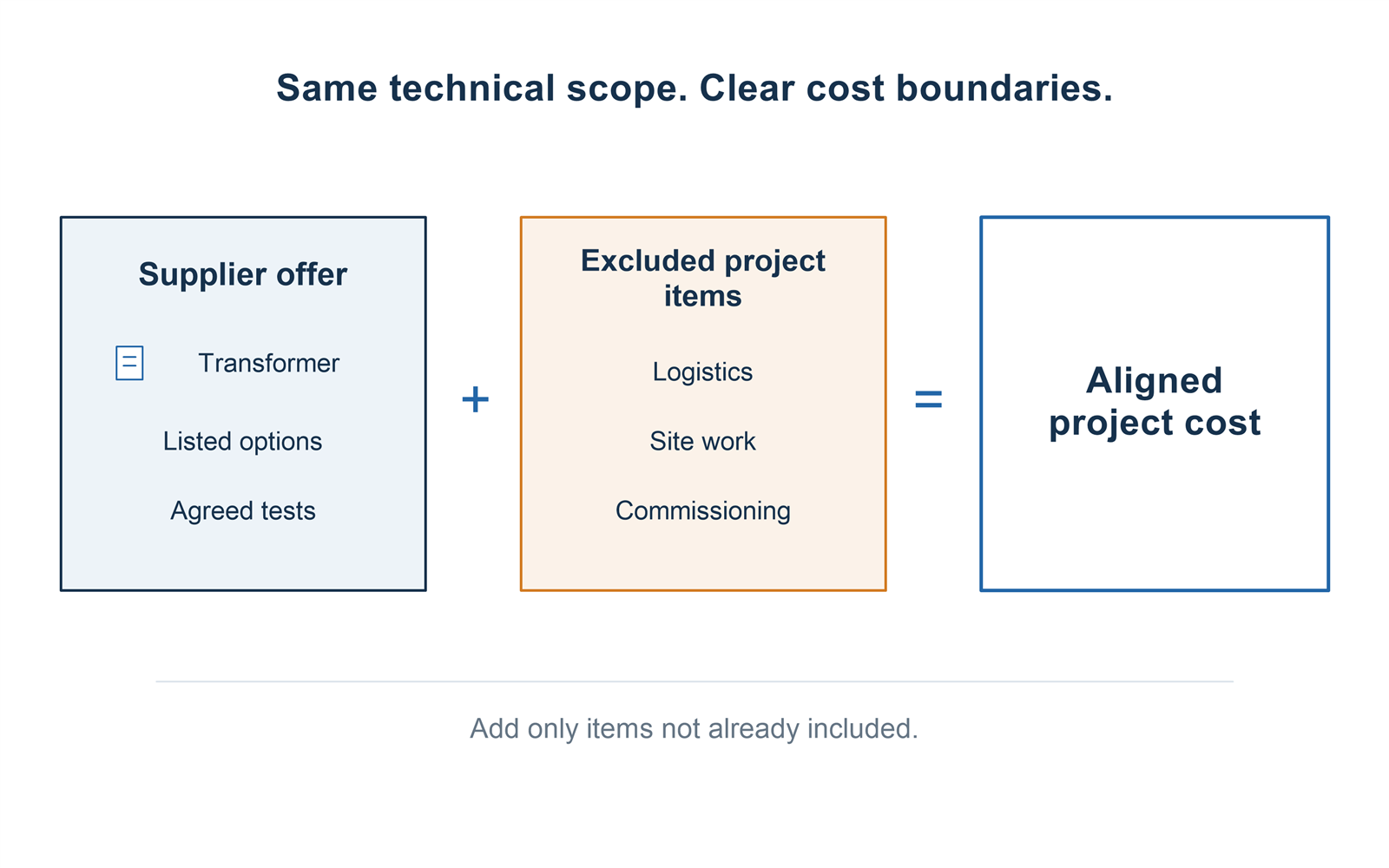
Use a separate line for unresolved allowances. A blank freight or commissioning entry should not silently become zero in the comparison. If the amount is still unknown, keep the uncertainty visible until a responsible party supplies it.
Fix the technical basis before asking for a lower price
A transformer’s specification includes more than capacity: voltage, frequency, insulation, winding arrangement, technology and service conditions all help define the equipment being offered.[1] Send bidders the same specification revision and ask them to return a deviation schedule.
The baseline should identify:
- Quantity, rated capacity, primary and secondary voltages, phases and frequency.
- Winding connection, accessible neutral, required impedance and tap arrangement.
- Dry-type or liquid-filled construction, cooling arrangement and enclosure requirements.
- Ambient conditions, altitude, installation location and relevant load characteristics.
- Required loss guarantees, applicable standards and acceptance documents.
Use the transformer specification checklist to settle missing inputs before comparing commercial offers. If a requirement is still under engineering review, label it as open and request a clearly stated assumption.
Ask bidders to separate the compliant base offer from alternatives. A different winding material, tap arrangement or cooling package should have an identifiable technical scope and price effect. Do not accept a substitution solely because its capacity matches.
For IEC-based procurement, identify the relevant parts and editions in the specification. IEC 60076-1 covers general requirements for power transformers, with stated exceptions and relationships to other standards.[5] Writing only “IEC compliant” does not establish the documents or tests included in a particular offer.
Make accessories and project interfaces visible
Ask for an itemized equipment schedule. Where required, it should distinguish the transformer from its enclosure, cable boxes, terminal arrangements, temperature monitoring, cooling controls, protection accessories and spare parts. Mark optional items separately so they cannot disappear into a base-price comparison.
Check the interfaces against the installation drawing. Which party supplies the cable terminations? Does the scope include a connection to adjacent equipment, or only transformer terminals? Who provides the foundation, containment arrangements where required, and access for handling equipment?
Treat factory inspection, transport preparation, site assembly and commissioning as separate scope questions. State which checks and records the contract requires, whether witnessing is needed, and who pays for attendance or repeat visits. Request the proposed inspection and test plan instead of assuming that “tested” includes every project acceptance activity.
Compare the selected configuration, not a whole product family. The SC(B)13 cast-resin dry-type transformer and S13-M oil-immersed distribution transformer pages can help identify the configuration questions to resolve; the quotation still needs a specific rating and supplied arrangement.
Evaluate losses with one operating scenario
No-load loss is measured with rated voltage and frequency applied and the other winding open.[3] It matters when assessing a transformer that remains energized even with little useful load. Load-loss information addresses the current-dependent part; Schneider Electric’s guidance distinguishes core loss from full-load coil loss and advises requesting current design data when losses are critical.[2]
Request guaranteed no-load and load losses, their units, reference conditions and applicable acceptance tolerances. Use the same loading profile, energized hours, energy-price basis and evaluation period for every offer. Include auxiliary consumption where relevant. An efficiency percentage without its operating point is insufficient for this comparison.
Keep the loss assumptions beside the equipment price so the reason for any price premium is visible.
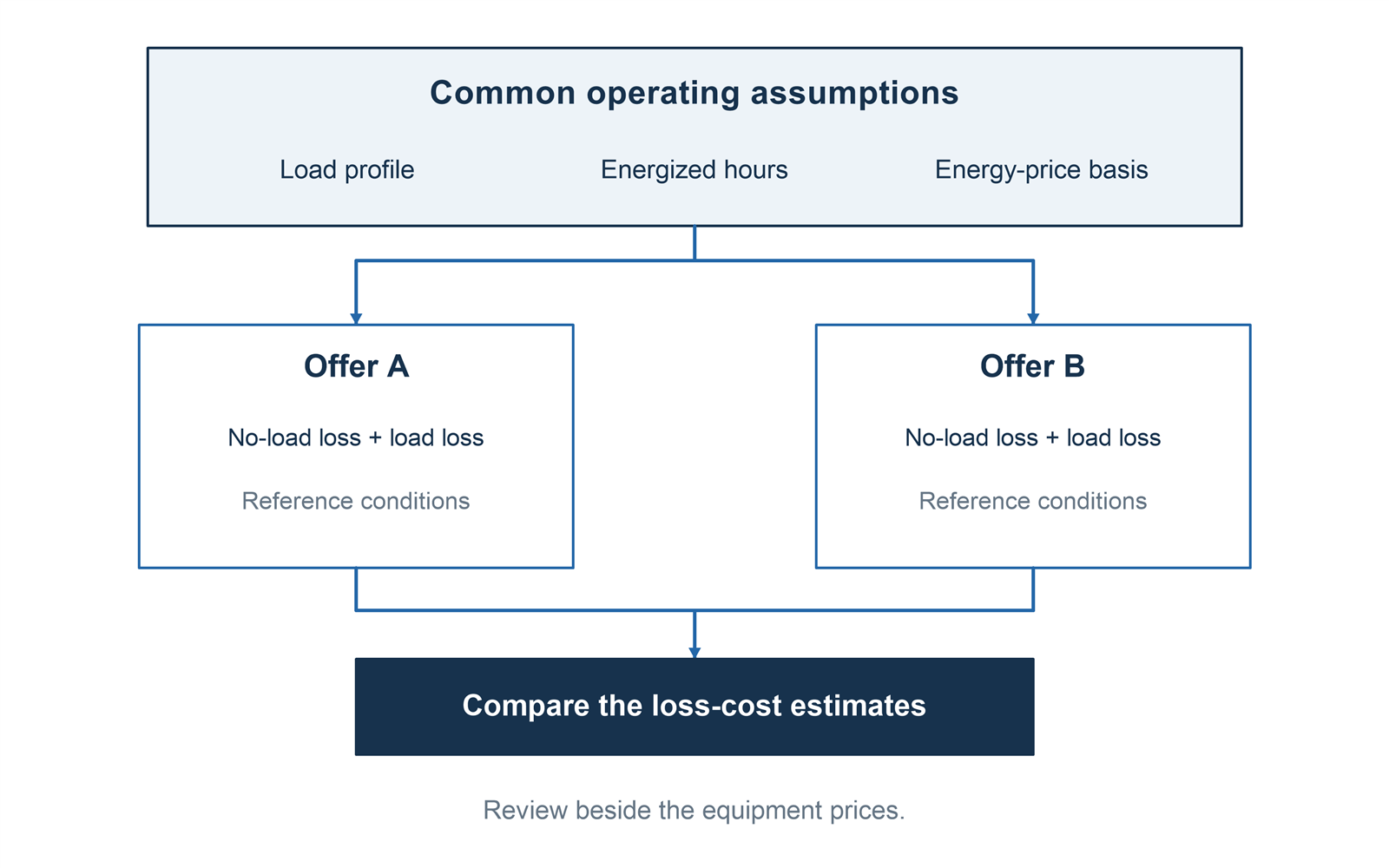
For the calculation, have the project engineer apply the agreed load profile to the offered loss data. If the budget uses a discounted lifetime evaluation, apply the same method to all bidders. Do not add a capitalized loss allowance and the same future energy cost again.
When operating hours or future loading remain uncertain, compare plausible scenarios and show whether the preferred offer changes. That is more useful than presenting a precise savings figure built on an unconfirmed duty cycle.
Specify the delivery point and handling responsibilities
If the contract uses Incoterms 2020, name the chosen rule and the agreed place or port. ICC describes these rules as allocating costs, risks and obligations between buyer and seller.[4] Check the selected rule alongside the quotation rather than treating “delivery included” as a complete scope definition.
For the project comparison, confirm packing, freight, insurance where applicable, import arrangements, taxes, unloading, placement and storage. Assign each item to a party and identify any cost excluded from the supplier’s price. Have the contract team resolve unclear responsibilities before accepting the offer.
Request shipping dimensions and shipping mass for the offered configuration. Distinguish transport condition from final installed condition, including anything shipped separately. Use that information to check access routes, lifting arrangements and the receiving plan; do not substitute a catalog weight for the actual shipment.
Ask when the lead-time clock starts and stops
Require the supplier to define the starting milestone behind its quoted lead time: order acceptance, payment, technical clarification, drawing approval, or another agreed event. Also define the endpoint. Ready for dispatch, arrival at site and ready for service are different milestones.
Ask for a schedule showing the approval, production, testing, dispatch and transport stages, including any activities that overlap. Record buyer review deadlines and the effect of specification changes. The sequence and duration need confirmation for the actual order.
Record the starting condition and delivery endpoint beside every quoted duration.
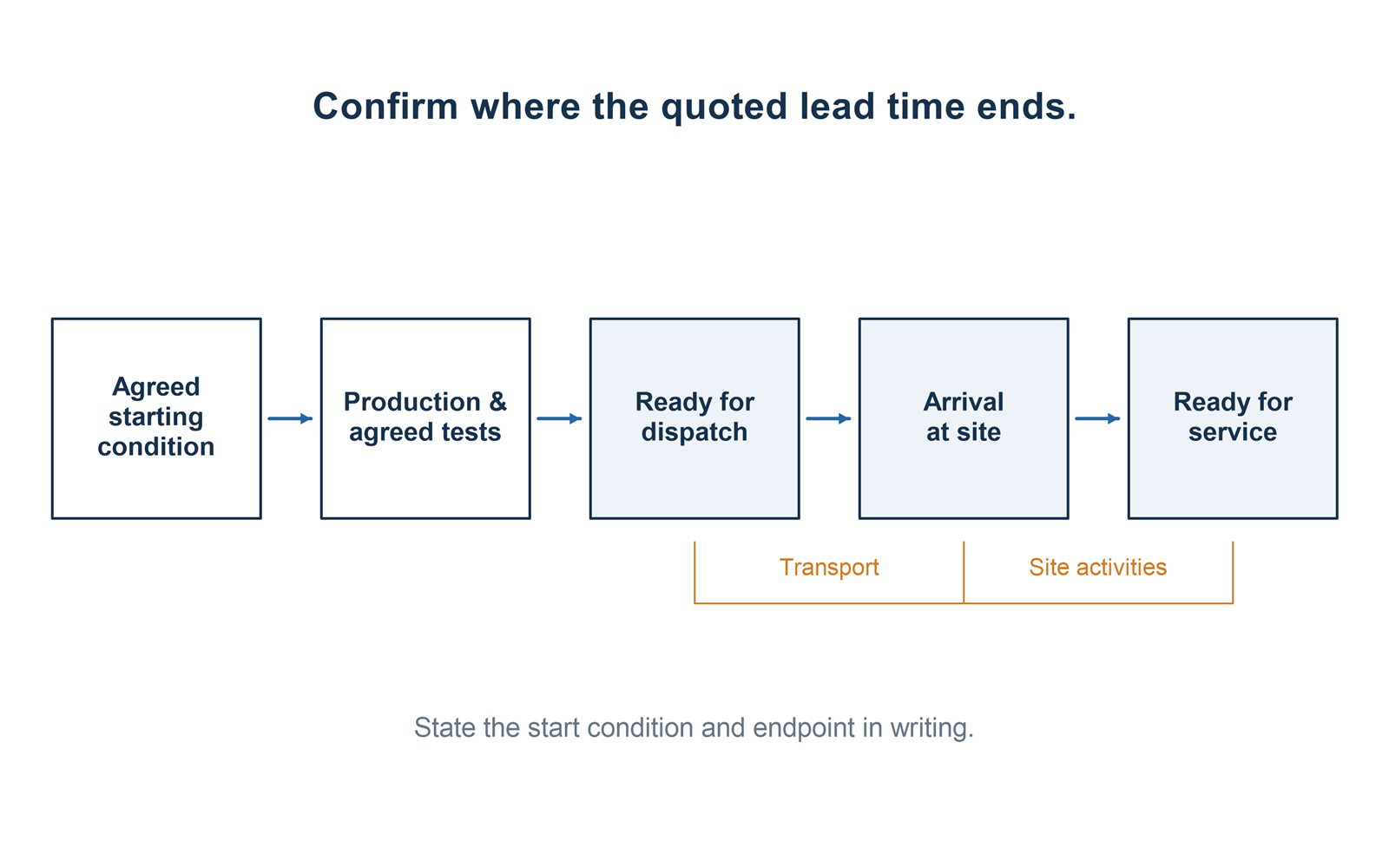
If a bidder offers an earlier date by changing the design, treat that as a separate technical proposal. Keep it outside the compliant comparison until the responsible engineer approves the change. Review quotation validity and any price-adjustment conditions at the same time as the schedule.
Use one comparison sheet for every bidder
Copy this structure into the RFQ and require a response in every row. Replace the dashes with the bidder’s confirmed scope or an explicitly unresolved item.
| Comparison item | Common basis to establish | Offer A | Offer B |
|---|---|---|---|
| Equipment and quantity | Same specification revision, rating and quantity | — | — |
| Technical deviations | Accepted base offer; alternatives priced separately | — | — |
| Accessories and interfaces | Included items and supply boundaries | — | — |
| Loss guarantees | Values, reference conditions and evaluation assumptions | — | — |
| Tests and documents | Agreed activities, witnessing and records | — | — |
| Delivery and site work | Named delivery point and assigned responsibilities | — | — |
| Excluded project costs | Allowances added once, with their source | — | — |
| Lead time | Starting milestone, endpoint and approval dependencies | — | — |
| Commercial terms | Currency, validity, payment, taxes and adjustment terms | — | — |
| Warranty and support | Coverage, start event, exclusions and service scope | — | — |
Resolve technical exceptions before ranking the totals. For acceptable offers, compare the aligned project cost, then review losses and schedule using the shared assumptions. Keep unresolved costs and responsibilities visible in the recommendation.
Send an RFQ that can be answered consistently
Attach the single-line diagram, specification revision, quantity, installation conditions, delivery location and required completion milestone. Include the comparison sheet and ask the supplier to return it with the configuration schedule, drawings, loss data, deviations and commercial terms.
If the project is still at budget stage, request a budgetary offer with its assumptions and validity stated. Before placing an order, close the design and scope gaps in a revised quotation. That gives the purchasing decision a documented basis that engineering, logistics and the supplier can all check.
Before you compare transformer quotes
Obtain a budgetary quote for a defined capacity, voltage ratio, construction, quantity and delivery point. Require the supplier to list assumptions and exclusions. A price range without those inputs cannot establish the cost of the transformer package your project needs.
Use price per kVA only as an initial check between technically comparable offers with aligned scope. It does not account for differences in accessories, loss guarantees, delivery responsibilities or site work. Resolve those differences before ranking suppliers.
Evaluate the offered losses against the same operating scenario and equipment-price difference. Ask the project engineer to compare energized hours, loading and the evaluation period. If the loading assumptions are uncertain, show how different scenarios affect the decision.
Ask the bidder to state the endpoint. A schedule ending at factory dispatch leaves transport and site activities to be addressed separately. Record the starting milestone, the delivery destination and who owns each remaining activity.
Request clarification and keep the item marked as unresolved. Do not assume that a blank means included or free. For an external allowance, record the provider, scope and validity so it can be checked alongside the supplier’s offer.
Sources
